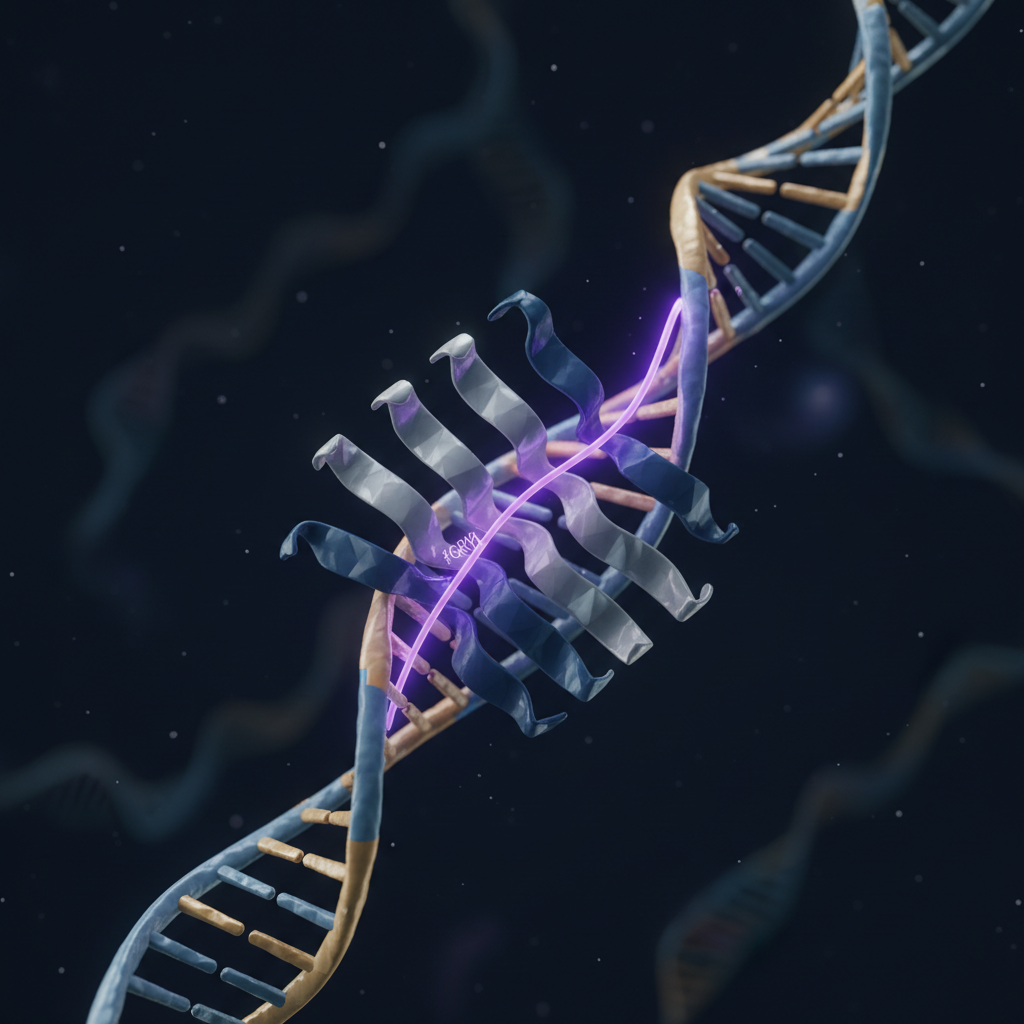
The two essential ingredients
For all its reputation, the core of CRISPR-Cas9 is remarkably minimal. It needs just two components to find and edit a specific gene:
- A guide RNA (gRNA) — a short, custom-made RNA sequence (about 20 letters long) that matches the exact DNA sequence the researcher wants to target. This is the "address."
- The Cas9 enzyme — a protein that acts as molecular scissors, capable of cutting both strands of the DNA double helix.
To aim CRISPR at a new gene, a scientist doesn't rebuild the whole machine — they simply design a new guide RNA. This is precisely why CRISPR was such a leap forward over earlier tools like zinc-finger nucleases and TALENs, which required engineering an entirely new custom protein for each target.
"The CRISPR-Cas9 system works similarly in the lab. Researchers create a small piece of RNA with a short 'guide' sequence that attaches to a specific target sequence of DNA in a genome." — NIH MedlinePlus Genetics
Step 1 — Targeting: the guide RNA finds its match
Once introduced into a cell, the guide RNA and Cas9 join together to form a complex. The guide RNA then scans the genome, looking for a stretch of DNA whose sequence is complementary to its own ~20-letter guide region.
The genome is enormous — about 3 billion letters in humans — so this targeting precision is what makes CRISPR useful. The guide RNA effectively narrows that vast search down to a single intended site.
Step 2 — The PAM check: a built-in safeguard
Finding a matching sequence isn't enough. Before Cas9 will cut, it must also recognize a short DNA signature located right next to the target, called a PAM (protospacer adjacent motif). For the common Cas9 from Streptococcus pyogenes, the PAM is a simple three-letter sequence (NGG).
The PAM acts as a molecular safety check. It ensures Cas9 only cuts at sites that are genuinely flanked by this signal — and, importantly, it's also how bacteria avoid cutting their own CRISPR storage region. No PAM, no cut.
Step 3 — The cut: a double-strand break
When the guide RNA matches the target and a PAM is present, Cas9 changes shape and activates its two cutting domains. Each domain severs one strand of the DNA, producing a clean double-strand break at the precise target location.
At this point, the DNA is broken — but no edit has actually been made yet. The break is simply the trigger.
Step 4 — Repair: where the edit really happens
A double-strand break is dangerous to a cell, so it rushes to repair it. This repair process is where the actual genetic edit is created, and it follows one of two main pathways:
- Non-Homologous End Joining (NHEJ) — the cell's fast, default repair. It glues the broken ends back together but is error-prone, often inserting or deleting a few letters. These small errors frequently disable ("knock out") the targeted gene — useful when the goal is to switch a gene off.
- Homology-Directed Repair (HDR) — a slower, far more precise pathway. If researchers also supply a DNA repair template, the cell can use it to rewrite the broken region exactly, correcting a mutation or inserting a new sequence.
Which pathway dominates depends on the cell type and conditions — and steering repair toward precise HDR remains one of the field's central technical challenges.
The mechanism, summarized
Here is the full process at a glance:
Beyond cutting: editing without a break
The classic mechanism above relies on cutting both DNA strands — but newer CRISPR tools avoid that. Base editors chemically convert one DNA letter into another (for example, C to T) without making a double-strand break, while prime editors use a modified Cas9 paired with a reverse transcriptase to "search and replace" short stretches of DNA. Both approaches aim to reduce the unpredictability of relying on the cell's repair machinery. These are covered in depth on the CRISPR vs. other gene-editing tools page.
Why the mechanism matters for safety
Understanding the mechanism also clarifies where the risks live. Because targeting depends on a ~20-letter match, Cas9 can occasionally cut at unintended sites that look similar to the target — known as off-target effects. And because the final edit depends on unpredictable cellular repair, the exact outcome can vary. These two facts — imperfect targeting and variable repair — underpin most of the safety research in therapeutic CRISPR.