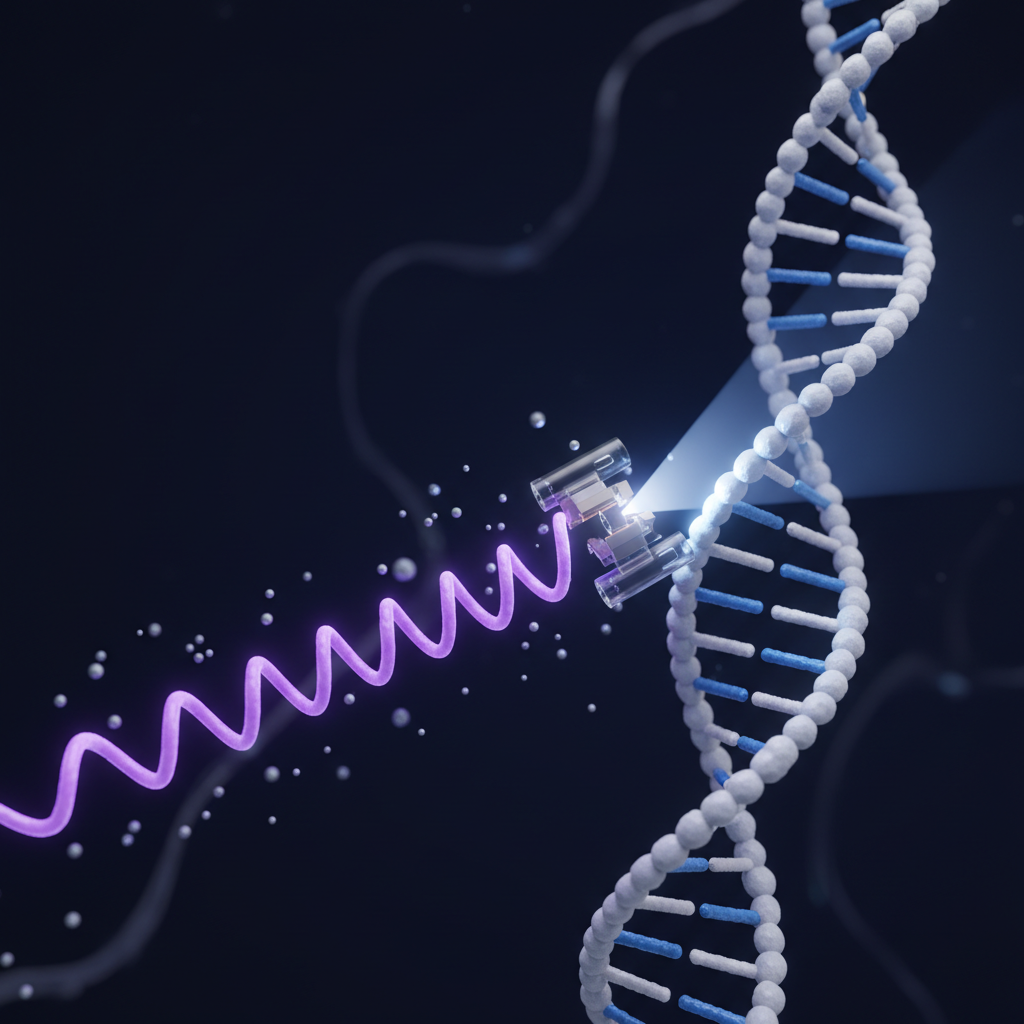
What the term means
CRISPR (pronounced "crisper") is short for clustered regularly interspaced short palindromic repeats. The name refers to a distinctive pattern in bacterial DNA: short, repeated sequences separated by unique "spacer" sequences. Those spacers are fragments of genetic code captured from viruses that previously attacked the cell.
According to the National Human Genome Research Institute (NHGRI), CRISPR is "a technology that research scientists use to selectively modify the DNA of living organisms," adapted from naturally occurring genome-editing systems found in bacteria. In everyday conversation, "CRISPR" is often used as shorthand for the whole gene-editing toolkit — but strictly speaking, it names the repeated DNA pattern that the system is built around.
"CRISPR is a technology that can be used to edit genes and, as such, will likely change the world." — Broad Institute, Questions and Answers about CRISPR
Where CRISPR comes from
CRISPR sequences were first noticed in the genome of E. coli in 1987, but their purpose was a mystery for nearly two decades. In the early 2000s, Francisco Mojica at the University of Alicante in Spain studied these repeats across many microbes and proposed a radical idea: they are part of a bacterial adaptive immune system.
The logic is elegant. When a virus (a bacteriophage) infects a bacterium, the cell can grab a small fragment of the invader's genetic code and file it away between the CRISPR repeats as a "spacer." That spacer becomes a molecular memory. If the same virus attacks again, the bacterium transcribes the stored spacer into RNA, uses it to recognize the matching viral DNA, and deploys a Cas (CRISPR-associated) enzyme to cut that DNA apart — neutralizing the threat.
In other words, bacteria have been doing precise, sequence-targeted DNA cutting for billions of years. Scientists simply learned to borrow the mechanism.
From bacterial defense to laboratory tool
The leap from "interesting microbiology" to "revolutionary tool" happened fast:
- 2012 — Jennifer Doudna and Emmanuelle Charpentier published a landmark study showing that the CRISPR-Cas9 system could be programmed with a single guide RNA to cut DNA at any chosen sequence in a test tube.
- January 2013 — Feng Zhang's lab at the Broad Institute, and George Church's lab at Harvard, independently demonstrated CRISPR-Cas9 editing inside living mammalian cells, including human cells.
- 2020 — Doudna and Charpentier were awarded the Nobel Prize in Chemistry "for the development of a method for genome editing."
Together, these advances turned a curious feature of bacterial biology into one of the most widely used tools in modern molecular biology.
How the basic system works
The most common version, CRISPR-Cas9, has just two essential parts:
- A guide RNA (gRNA) — a short, custom-designed RNA sequence (~20 letters) that matches the DNA target a researcher wants to edit.
- The Cas9 enzyme — a protein that acts like molecular scissors, cutting both strands of DNA.
The guide RNA leads Cas9 to the matching DNA sequence. Before it can cut, Cas9 must find a short signature sequence next to the target called the PAM (protospacer adjacent motif) — a built-in safety check that stops the system from cutting random DNA. Once the PAM is confirmed and the guide RNA matches, Cas9 cuts the DNA.
The cell then tries to repair the break, and this repair step is where the actual edit happens:
- Non-homologous end joining (NHEJ) — a quick, error-prone repair that often disables ("knocks out") a gene.
- Homology-directed repair (HDR) — a precise repair that, if a DNA template is supplied, can insert or correct a specific sequence.
Key terminology at a glance
The vocabulary around CRISPR can be confusing because the same words get used loosely. Here is what each term actually refers to:
Newer editing tools beyond Cas9
CRISPR is no longer just "Cas9 cutting DNA." Two newer approaches edit more precisely, often without making a full double-strand break:
- Base editing chemically converts one DNA letter into another (for example, C→T) at a target site, without cutting both strands.
- Prime editing uses a modified Cas9 paired with a reverse transcriptase enzyme to "search and replace" short stretches of DNA with even greater flexibility.
These tools, developed largely in David Liu's lab at the Broad Institute, are designed to reduce unwanted errors — a major focus of current research published in journals such as Nature.
Why CRISPR mattered so much
Before CRISPR, editing a specific gene was possible but slow, expensive, and technically demanding — earlier tools like zinc-finger nucleases and TALENs had to be re-engineered as whole proteins for each new target. CRISPR's breakthrough is programmability: to aim at a new gene, a researcher just orders a different short guide RNA. That single change made targeted genome editing dramatically cheaper and more accessible, opening the field to thousands of labs.
What CRISPR is — and isn't
It is worth being precise about scope. CRISPR is primarily a research technology, and for most conditions it is not a finished medical treatment. A small number of CRISPR-based therapies have now been approved — most notably Casgevy (exa-cel), the first CRISPR therapy approved by the FDA (December 2023) for sickle cell disease and beta thalassemia. But the overwhelming majority of CRISPR applications remain experimental or confined to the laboratory.
CRISPR also does not "rewrite" an entire genome on command. It makes targeted edits, and doing those edits safely and accurately inside living people — avoiding off-target changes and delivering the machinery to the right cells — remains an active scientific challenge.