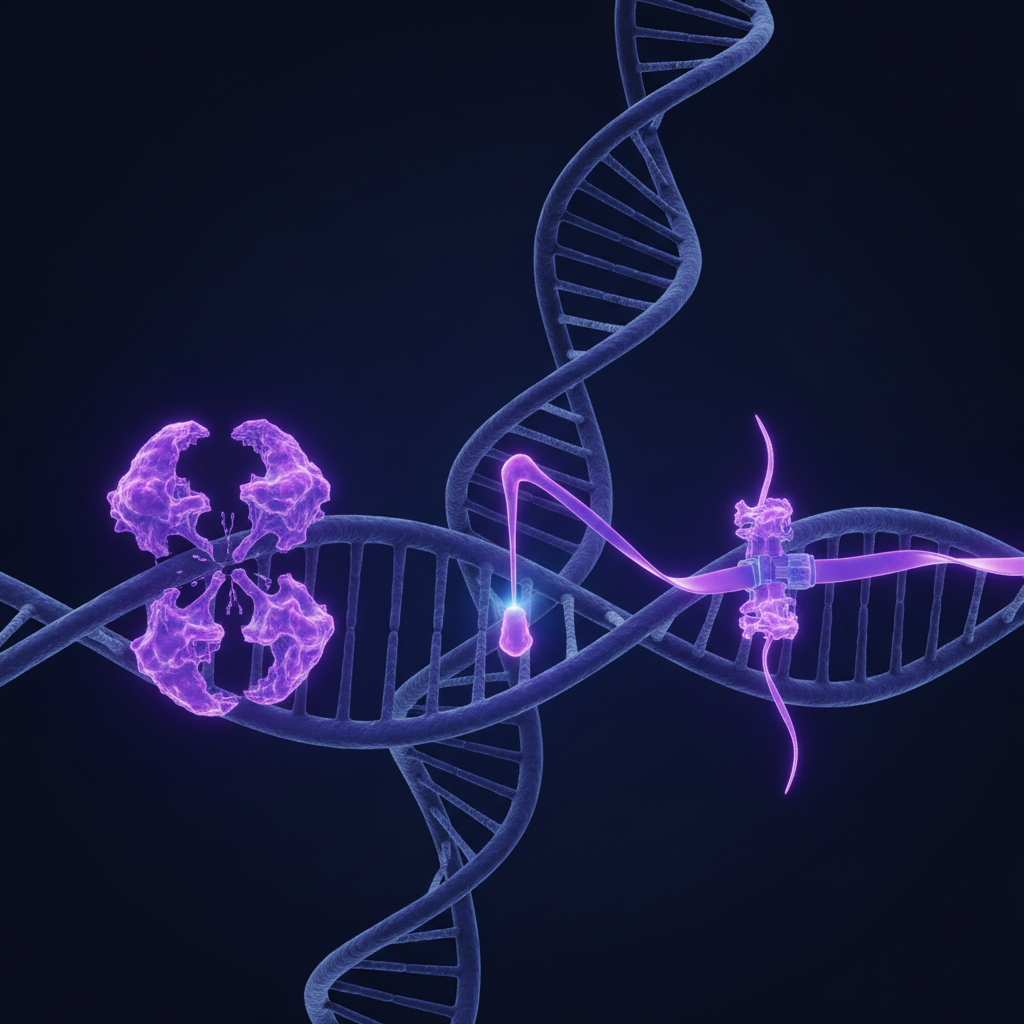
CRISPR didn't invent gene editing
It's a common misconception that CRISPR was the first way to edit genes. It wasn't. Scientists had been making targeted changes to DNA for decades before CRISPR arrived. What CRISPR changed was not whether genes could be edited, but how easily.
To appreciate why CRISPR caused such a shift, it helps to understand the tools that came before — and the even newer tools now emerging from within the CRISPR family itself.
The earlier generation: ZFNs and TALENs
Two technologies dominated targeted gene editing before CRISPR:
- Zinc-finger nucleases (ZFNs) — engineered proteins that combine a custom DNA-binding region with a DNA-cutting domain. First developed in the 1990s.
- TALENs (transcription activator-like effector nucleases) — a later, somewhat more flexible protein-based system working on a similar principle.
Both could cut DNA at a chosen location and trigger the same cellular repair pathways CRISPR relies on. So what was the problem?
Each new target required a brand-new protein. With ZFNs and TALENs, the targeting information is built into the structure of the protein itself. To aim at a different gene, researchers had to design, build, and validate an entirely new custom protein — a process that could take months and demanded significant expertise and cost.
Why CRISPR changed the economics
CRISPR's key insight was to separate targeting from cutting. Instead of encoding the target in a complex protein, CRISPR uses the same Cas9 enzyme every time and changes only the guide RNA — a short, cheap, easily synthesized piece of RNA.
"In recent years, [scientists] have developed faster, cheaper, and more precise methods" of genome editing. — NIH MedlinePlus Genetics
The practical impact was enormous. Re-targeting CRISPR to a new gene takes a new guide RNA that can be ordered and ready in days, at a fraction of the cost. This accessibility is what democratized gene editing and triggered the explosion of CRISPR research after 2012.
A side-by-side comparison
The next generation: editing without a break
The story doesn't end with standard CRISPR-Cas9. The field's frontier is now defined by tools that edit DNA more precisely than cutting allows. Crucially, these are still CRISPR-based — they use a modified Cas9 to target DNA, but change how the edit is made.
Base editing
Standard Cas9 cuts both DNA strands and relies on the cell's unpredictable repair. Base editing avoids that entirely. It uses a disabled Cas9 that no longer cuts, fused to an enzyme that chemically converts one DNA letter directly into another (for example, C→T or A→G) at the target site. Because there's no double-strand break, base editing tends to produce cleaner, more predictable single-letter changes — valuable for correcting the many genetic conditions caused by a single-letter mutation.
Prime editing
Prime editing goes further, functioning like a molecular "search-and-replace." It pairs a modified Cas9 with a reverse transcriptase enzyme and a special guide RNA that carries the desired edit. This lets it rewrite short stretches of DNA — small insertions, deletions, or letter swaps — with great flexibility and without depending on a double-strand break. Prime editing is newer and largely preclinical, but it dramatically expands the range of edits CRISPR can, in principle, achieve.
So which tool is 'best'?
There is no universal winner. The right tool depends on the job:
- To simply disable a gene, standard CRISPR-Cas9 is often sufficient.
- To correct a single-letter mutation cleanly, base editing may be preferable.
- To make a specific, complex edit, prime editing offers the most flexibility.
- ZFNs and TALENs still have niche roles, particularly where their distinct properties matter or for established therapeutic programs.
The broader trend is clear: gene editing is moving steadily from blunt cutting toward precise, programmable rewriting — and CRISPR-based tools are leading that shift.