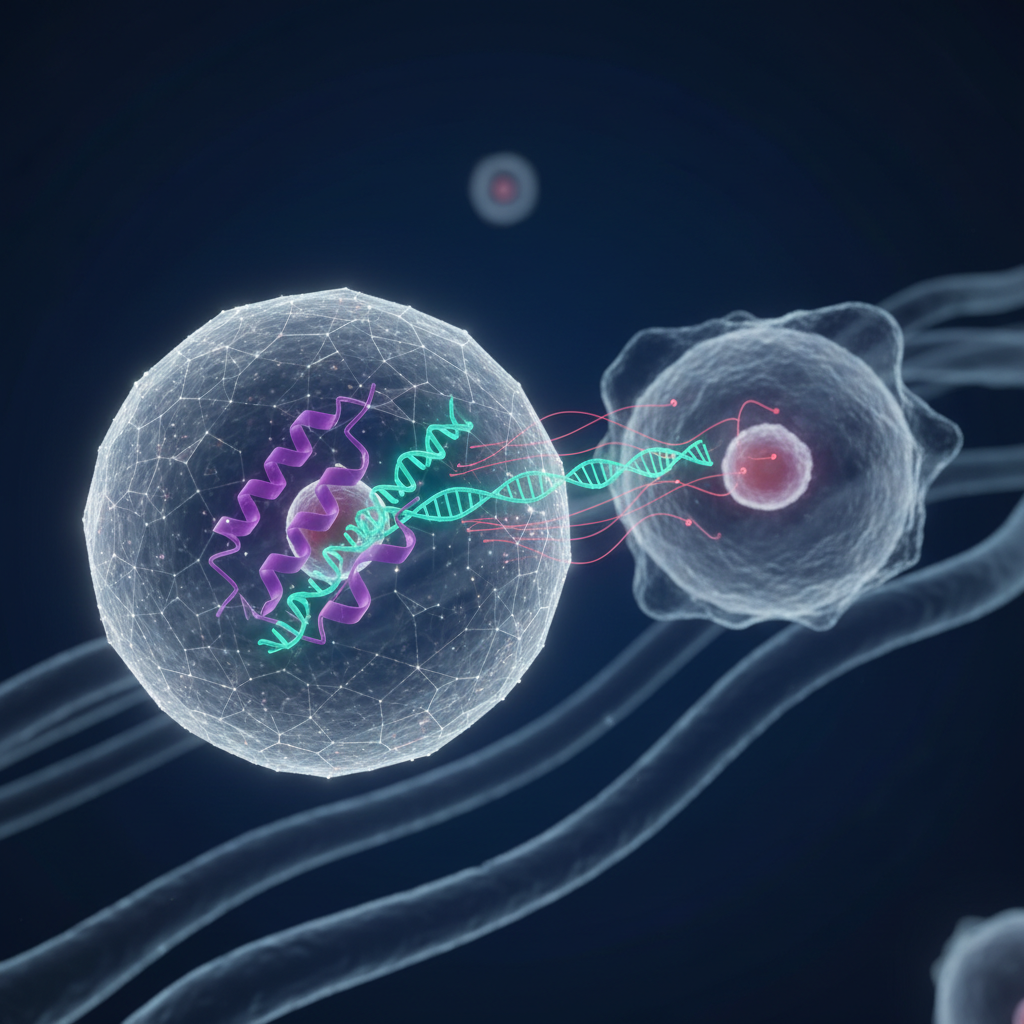
Why delivery is the real bottleneck
It is easy to assume the hard part of CRISPR is the editing itself. In reality, scientists have been able to cut DNA precisely in a test tube for over a decade. The genuine engineering challenge — the one that decides which diseases CRISPR can treat — is delivery: getting a relatively large protein (Cas9) and its guide RNA into the right cells, inside a living body, without triggering the immune system or harming healthy tissue.
Every medical application of CRISPR is, at its core, a delivery problem. Understanding the two delivery strategies is the key to understanding why some diseases were treatable first and others remain years away.
Ex vivo: editing cells outside the body
The most clinically mature approach is ex vivo editing — Latin for "outside the living."
- Target cells (usually blood or immune cells) are removed from the patient.
- CRISPR edits them in a controlled laboratory dish.
- The edited cells are checked, then infused back into the patient.
This sidesteps the delivery problem entirely: there is no need to navigate the bloodstream or evade the immune system, because the editing happens in a dish. The first approved CRISPR therapy, Casgevy, works this way — which is exactly why blood disorders were treatable first.
The limitation is obvious: ex vivo only works for cells you can remove and return. You cannot take out a brain, a heart, or a pair of lungs, edit them, and put them back.
In vivo: editing inside the body
For everything else, the editing must happen in vivo — inside the living body. This is dramatically harder, and it relies on two main delivery vehicles:
Lipid nanoparticles (LNPs)
LNPs are tiny fat bubbles that encapsulate the CRISPR machinery and protect it as it travels through the bloodstream. This is the same core technology that delivered mRNA COVID-19 vaccines. LNPs have a useful natural tendency: after injection, they accumulate heavily in the liver.
This is why the earliest in vivo CRISPR trials target liver-based conditions — for example, editing the PCSK9 gene to lower cholesterol, or the TTR gene to treat a protein-misfolding disease (transthyretin amyloidosis). The liver is, for now, the most accessible in vivo target.
Engineered viruses (AAV)
Viruses are nature's delivery experts. Scientists strip a harmless adeno-associated virus (AAV) of its own genes and load it with CRISPR instructions. AAV can reach tissues LNPs struggle with, such as the eye or muscle — which is why the first in-body editing trial for inherited blindness injected CRISPR directly into the retina.
The trade-offs: AAV has limited cargo space, and because it is a virus, the immune system may recognize and react to it.
The safety question: off-target edits
The single most discussed safety concern in CRISPR is off-target editing.
CRISPR finds its target by matching a ~20-letter guide RNA to a matching DNA sequence. But the human genome is three billion letters long, and similar-looking sequences exist elsewhere. Occasionally, CRISPR may cut at one of these unintended sites — an off-target edit. In the wrong place, such an edit could, in principle, disrupt an important gene.
This is a real concern, but it is also one scientists actively engineer against:
- Smarter guide design. Computational tools predict and avoid sequences with risky look-alikes elsewhere in the genome.
- High-fidelity Cas enzymes. Re-engineered versions of Cas9 are far less tolerant of mismatches, so they cut only near-perfect matches.
- Whole-genome screening. Before any therapy reaches patients, edited cells are sequenced genome-wide to detect unintended changes.
Base and prime editing: safer by design
Classic CRISPR-Cas9 works by cutting both strands of the DNA double helix and letting the cell repair the break — a process that can occasionally introduce larger, unwanted changes. Two newer tools were designed to avoid this:
- Base editing chemically converts one DNA letter into another without cutting both strands, like a precise find-and-replace for a single letter.
- Prime editing can rewrite short stretches of DNA using a built-in template, again avoiding a full double-strand break.
Because they don't rely on a double-strand cut, both approaches reduce the risk of large unintended rearrangements — and they are now moving into their own clinical trials.
What this means in practice
Delivery and safety together explain the pace of CRISPR medicine. Diseases of cells that can be edited outside the body, or of the liver, are reachable today. Diseases of the brain, heart, and most solid tissues await better delivery vehicles. And every therapy, no matter the target, must clear an increasingly rigorous safety bar for off-target effects before it reaches a patient.