What Are Peptides? A Simple Guide for Beginners (2026)
Peptides are everywhere right now — in headlines, gym chats, and weight-loss clinics. But what are they actually? Here's the plain-English explanation, no PhD required.

Peptides are short chains of amino acids — the same building blocks your body uses to make proteins. Your body naturally produces thousands of peptides every day to do things like regulate blood sugar, repair tissue, and control appetite. In the last few years, scientists have learned to make synthetic versions of these peptides, and some have become hugely popular medicines — including the GLP-1 weight-loss drugs you've probably heard of, like Ozempic and Wegovy.
If you've been hearing about peptides for muscle growth, fat loss, anti-aging, or healing, this guide will explain what they actually are, how they work, which ones have real evidence behind them, and where the hype outruns the science.
What are peptides? (the simplest explanation)
Imagine the alphabet. Every word in English is built from 26 letters. Your body works the same way, except its "alphabet" is 20 amino acids. String a few amino acids together, and you get a peptide. String hundreds or thousands together, and you get a protein.
That's really it. A peptide is just a short chain of amino acids — typically anywhere from 2 to 50. Two amino acids? That's a dipeptide. Three? A tripeptide. Anything from about 50 amino acids up gets called a protein.
Your body makes peptides constantly. Insulin, the hormone that controls your blood sugar, is a peptide. Oxytocin, the so-called "love hormone," is a peptide. The signal that tells your brain you're full after a meal? Also a peptide.
Peptides vs. proteins vs. amino acids — what's the difference?
This is where most people get confused, so let's make it visual:
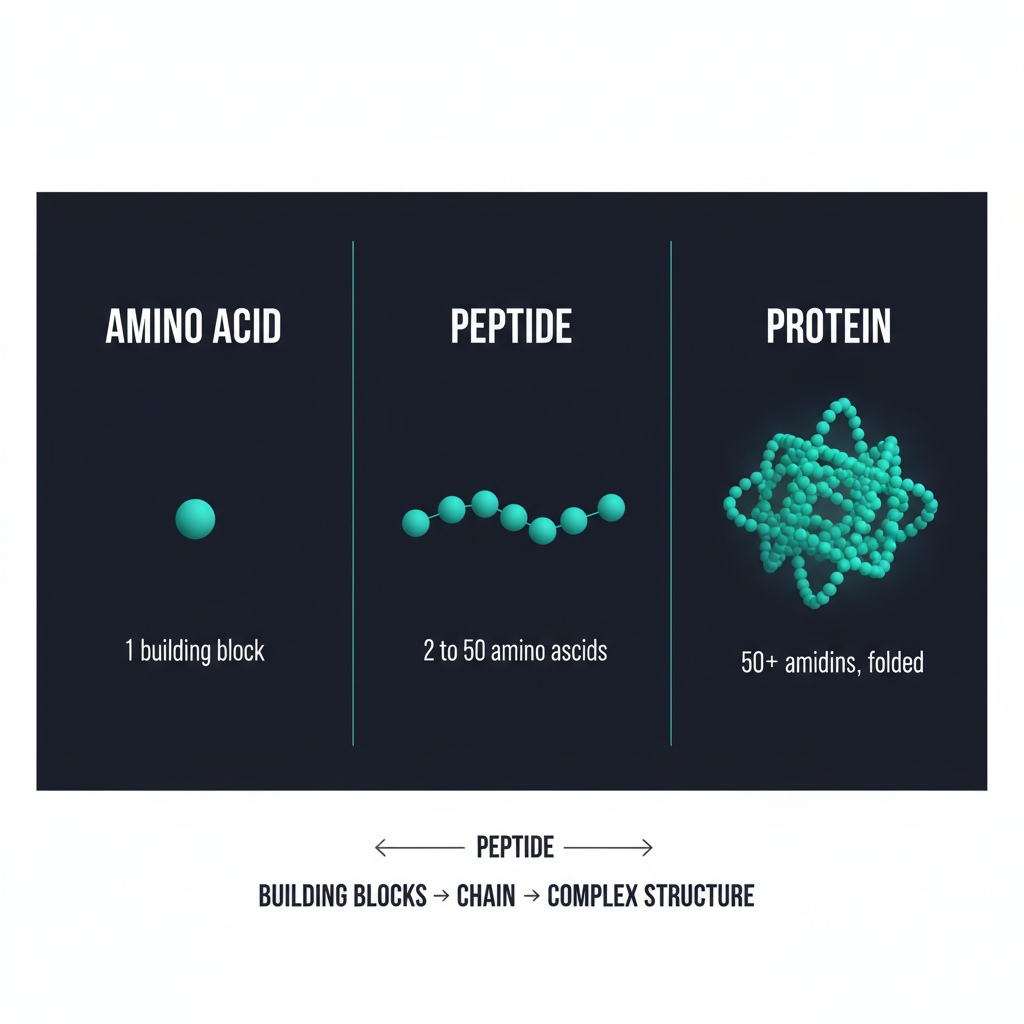
- Amino acid — a single building block. There are 20 of them in your body.
- Peptide — a short chain, usually 2 to 50 amino acids long. Easy for your body to absorb and signal with.
- Protein — a long, folded chain of 50+ amino acids. Used for structure (muscle, hair, enzymes) more than signaling.
The size matters a lot. Because peptides are small, they can fit into specific receptors on cells — like a key fitting into one specific lock. This is what makes them so useful as medicines: they can trigger a precise effect without hitting a hundred other systems at the same time.
How do peptides work in your body?
Peptides are essentially biological messengers. They travel through your bloodstream, find a specific receptor on a specific type of cell, bind to it, and trigger a response. Each peptide has its own "address" — it only talks to certain cells.
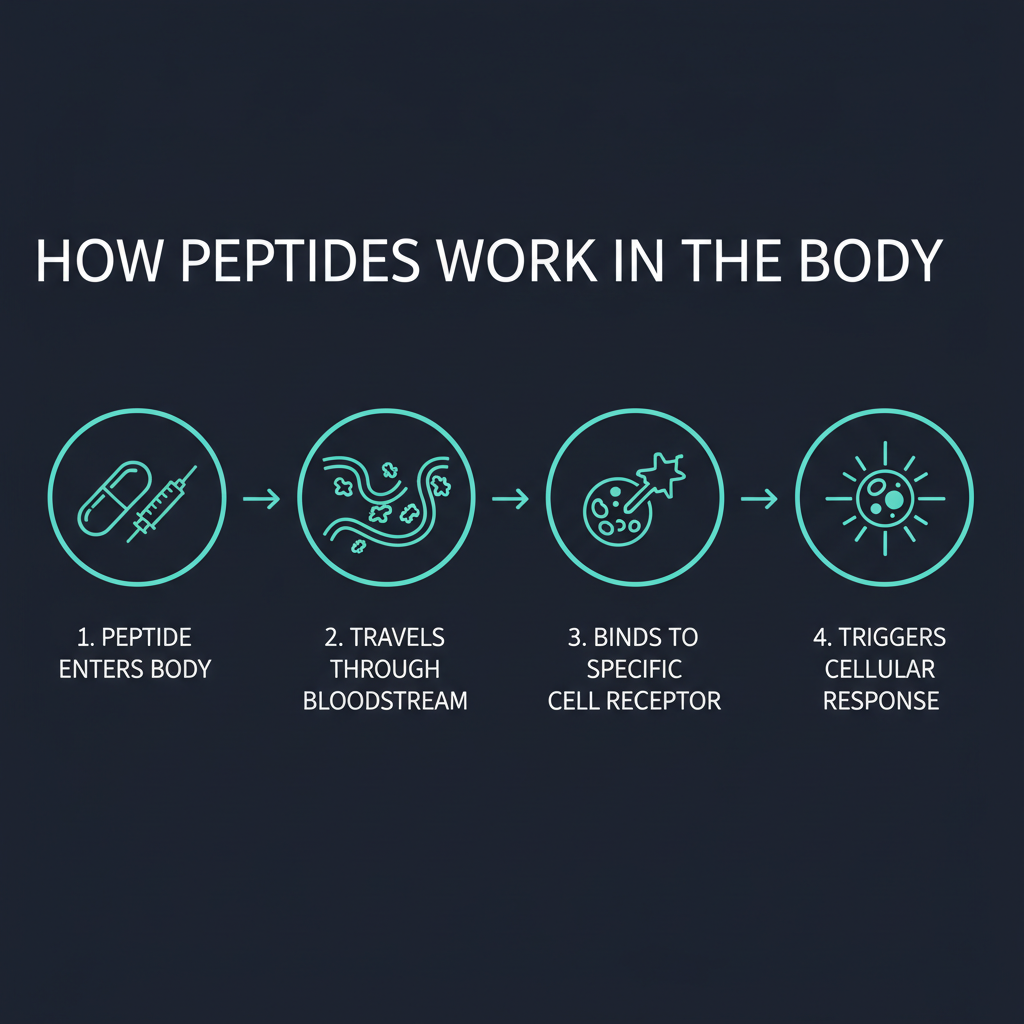
Here's a real-world example. GLP-1 (glucagon-like peptide-1) is a peptide your gut releases after you eat. It binds to receptors in your pancreas and brain and basically says two things: "release insulin" and "tell the body it's full." That's why GLP-1 mimicking drugs like semaglutide are so effective for both diabetes and weight loss — they're amplifying a signal your body already uses.
This is the core reason peptide medicines have exploded recently. They're targeted. Instead of broadly affecting hormones or systems, they hit one receptor and do one main thing.
The 6 main types of peptides (by what they do)
There are thousands of peptides, but for most people they fall into a handful of practical categories based on what people use them for:
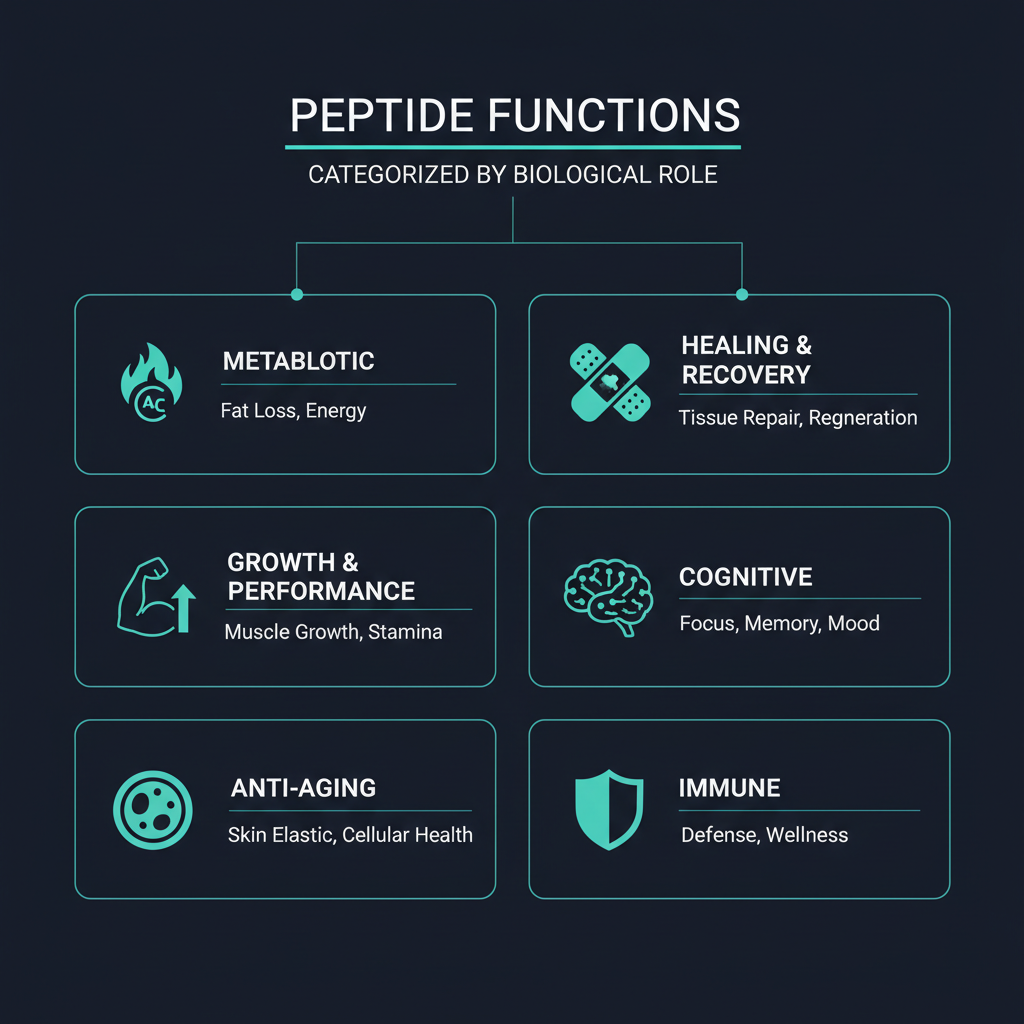
1. Metabolic peptides (weight loss & blood sugar)
The biggest category right now. Includes GLP-1 agonists like semaglutide (Ozempic, Wegovy), liraglutide (Saxenda), and the newer dual-agonist tirzepatide (Mounjaro, Zepbound). These help control blood sugar and reduce appetite. Strong evidence, FDA-approved.
2. Healing & recovery peptides
Often discussed in injury and post-surgery contexts. BPC-157 and TB-500 are the most-searched. Mostly animal data so far, with growing but still-limited human research. Research stage — not FDA-approved as medicines.
3. Growth & performance peptides
Popular in fitness and bodybuilding. Includes growth hormone secretagogues like ipamorelin, CJC-1295, and sermorelin. These nudge the pituitary gland to release more of your body's own growth hormone. Mixed evidence; legal status varies by country.
4. Cognitive peptides (nootropics)
Aimed at focus, memory, and brain health. Semax, Selank, and Cerebrolysin are common search terms. Mostly studied in Russia and Eastern Europe; less Western clinical research. Early-stage evidence.
5. Anti-aging & skin peptides
You've probably seen these on the back of a face cream. Matrixyl, copper peptides (GHK-Cu), and argireline are used topically for collagen support and wrinkle reduction. Decent cosmetic evidence; cosmetic, not medical claims.
6. Immune & longevity peptides
A newer category gaining attention. Includes thymosin alpha-1 (used in some countries for immune support) and epitalon (popular in longevity circles). Highly variable evidence; check sources carefully.
Popular peptides people actually search for
If you've been Googling peptides, these are probably the names you've come across. Here's a quick honest summary:
Semaglutide (Ozempic, Wegovy, Rybelsus)
A GLP-1 peptide. FDA-approved for type 2 diabetes and chronic weight management. Strong, well-replicated evidence. Side effects mainly digestive (nausea, especially early on).
Tirzepatide (Mounjaro, Zepbound)
A newer dual GLP-1 / GIP peptide. Generally shows even larger weight-loss effects than semaglutide in head-to-head trials. FDA-approved.
BPC-157
Body Protection Compound — a peptide derived from a stomach protein, used (mostly off-label) for tendon, ligament, and gut healing. Strong animal evidence. Human research is growing but still limited. Not FDA-approved.
Ipamorelin / CJC-1295
Growth hormone-releasing peptides used in some longevity and performance protocols. Limited large-scale human trials. Regulated differently in different countries.
Melanotan II
Searched for tanning effects. Carries documented safety concerns and is not approved for human use in most countries.
Copper peptides (GHK-Cu)
Common in skincare. Reasonable evidence for skin and wound applications when used topically.
Are peptides safe? Side effects, risks, and red flags
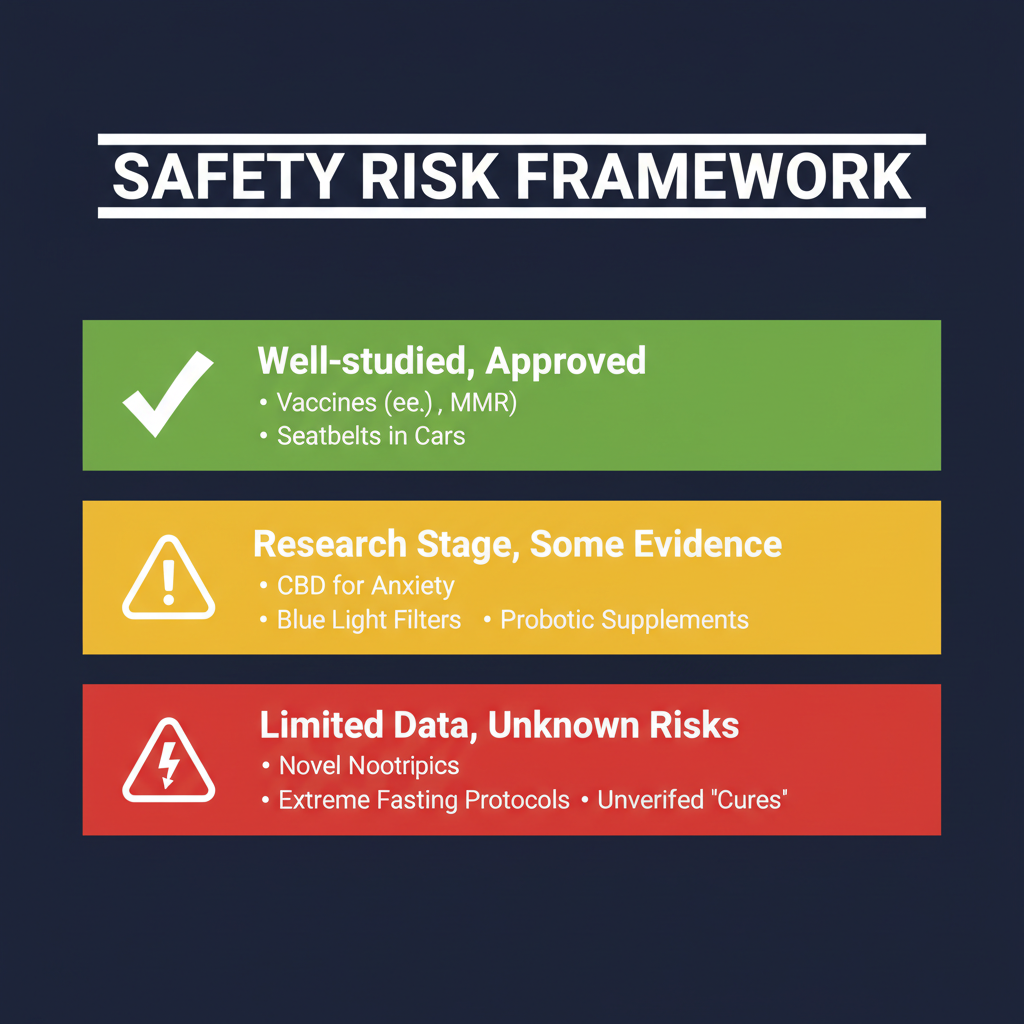
The honest answer: "Are peptides safe?" is the wrong question. The right question is: "Is this specific peptide, from this specific source, at this specific dose, safe for me?"
Peptides span a huge range. On one end, you have FDA-approved drugs that have been studied in tens of thousands of patients across decades. On the other end, you have research chemicals sold on questionable websites with no purity testing, no dosing guidelines, and no human trials.
Common side effects (when there are any)
- GLP-1 peptides: nausea, constipation, reduced appetite (especially during dose escalation).
- Injection-based peptides in general: redness or soreness at the injection site.
- Growth hormone-related peptides: water retention, joint aches, mild blood sugar changes.
- Less-studied peptides: the honest answer is — we don't fully know.
Red flags to watch for
- "Research chemicals" with no Certificate of Analysis or purity testing.
- Vendors who can't tell you the manufacturing source.
- Claims that sound like cure-alls ("fix anything," "no side effects").
- Anything promising fast, dramatic results without a clear mechanism.
- Sites that won't talk about side effects at all.
Are peptides legal?
Legality depends on three things: which peptide, which country, and how you're using it.
- FDA/EMA-approved peptides (semaglutide, insulin, liraglutide, tirzepatide, etc.) are legal medicines that require a prescription.
- "Research only" peptides (like BPC-157 in the US) are typically legal to sell labeled for laboratory research, but not for human use. Importing them for personal injection is a grey area in many countries.
- Banned substances: some peptides are on the WADA banned list for athletes (anything growth-hormone-related, GnRH peptides, etc.) — even if they're legal to possess.
- Outright prohibited peptides exist in some jurisdictions, especially anything tied to performance enhancement or specific safety concerns.
Bottom line: check the legal status of a specific peptide in your specific country before assuming anything. See the regulatory map →
How to research peptides responsibly
Most of the noise online about peptides falls into one of two camps: "This will change your life" or "This will kill you." The truth is almost always more nuanced. Here's a simple framework for cutting through it:
- Start with the evidence, not the marketing. Look for actual studies, not testimonials or before/after photos.
- Check the study type. A randomized controlled trial in humans is worth a hundred animal studies. A meta-analysis pooling many trials is even better.
- Look at sample size and replication. One small study showing a result is interesting. Five independent studies showing the same result is convincing.
- Separate "popular" from "proven." Some of the most-talked-about peptides have the weakest evidence base. Popularity is not data.
- Check the source if you ever consider using one. Purity, manufacturing, and third-party lab testing matter more than price.
- Talk to a qualified clinician. Especially one who actually reads the research and isn't selling the product.
This is exactly what PepVero exists for. Every peptide on the platform shows its Evidence Score (0–100), Risk Level, and the actual underlying studies — no hype, no shopping.
Frequently Asked Questions
Ready to go deeper?
Explore PepVero's full peptide research database — evidence scores, peer-reviewed studies, regulatory status, and safety profiles for 260+ peptides. No marketing. Just data.
Editorial standards: This article was written by the PepVero Research Team and reviewed for scientific accuracy against primary sources. It is provided for educational purposes only and is not medical advice. Always consult a qualified healthcare professional before making decisions about your health.
Last reviewed: May 12, 2026.