"Research Use Only" — What the Label Actually Means in 2026
Four words on a vial label do a lot of work in the peptide market. This guide explains where the RUO label came from, what it legally means under 21 CFR 809.10, what the FDA actually looks at when it inspects a peptide vendor, and why "Research Use Only" is not the legal shield most online sellers claim it is.

Four words — "For Research Use Only — Not for Human Consumption" — appear on almost every peptide sold online outside a licensed pharmacy. They look like a legal disclaimer. They function, for most buyers, as a kind of reassurance: someone has labeled this product, so someone is in charge of it. Neither assumption is correct.
The "RUO" label is a real category in U.S. regulation, but it was designed for something very different from what the peptide market uses it for. This article explains where the label actually comes from, what it legally covers, what the FDA looks at when it ignores the label (which is more often than you might think), and why the gap between "research-grade" and "pharmaceutical-grade" is not about purity in isolation — it is about the entire chain of evidence that makes a chemical safe to inject into a human body.
What "Research Use Only" actually means
In the strictly regulatory sense, "Research Use Only" is a labeling category for in-vitro diagnostic (IVD) reagents being developed before they are approved as clinical diagnostics. The category exists so that laboratories can buy and evaluate new reagents in a pre-market phase without those reagents being treated as approved medical devices.
What it does not mean — and what no FDA regulation says it means — is "this is safe to inject into a human, just not officially approved yet." That interpretation is a marketing convention invented by the online peptide market in the last fifteen years. It has no basis in FDA regulation and no standing in U.S. courts.
The single most important thing to internalize: the RUO label was never designed for the substances being sold under it today. The mismatch is not a technicality. It is the entire story.
The legal origin — 21 CFR 809.10(c)
The RUO label is defined in 21 CFR 809.10(c), the section of U.S. federal regulations governing labeling for in-vitro diagnostic products. The exact regulatory text requires that an RUO product be labeled prominently with the phrase "For Research Use Only. Not for use in diagnostic procedures." The category was created so that diagnostic reagents in development could move through laboratory evaluation before being submitted for FDA clearance.
In 2013, the FDA published a guidance document titled "Distribution of In Vitro Diagnostic Products Labeled for Research Use Only or Investigational Use Only." That guidance is the document most often cited by regulators today. It establishes one principle above all others: the label does not control regulatory classification — the totality of the circumstances does. If a manufacturer or distributor labels a product RUO while marketing it for diagnostic use, the FDA will treat it as a diagnostic device. The "RUO" wording becomes, in the regulator's view, a fig leaf rather than a defense.
The peptide market has imported this exact framework — and inherited every weakness of it. A vendor labeling a peptide "RUO" while publishing dosing protocols and injection guides is in precisely the same position as a diagnostic-reagent manufacturer labeling a kit "RUO" while marketing it for clinical use. The label is not the question. The marketing is.
How the peptide market borrowed the label
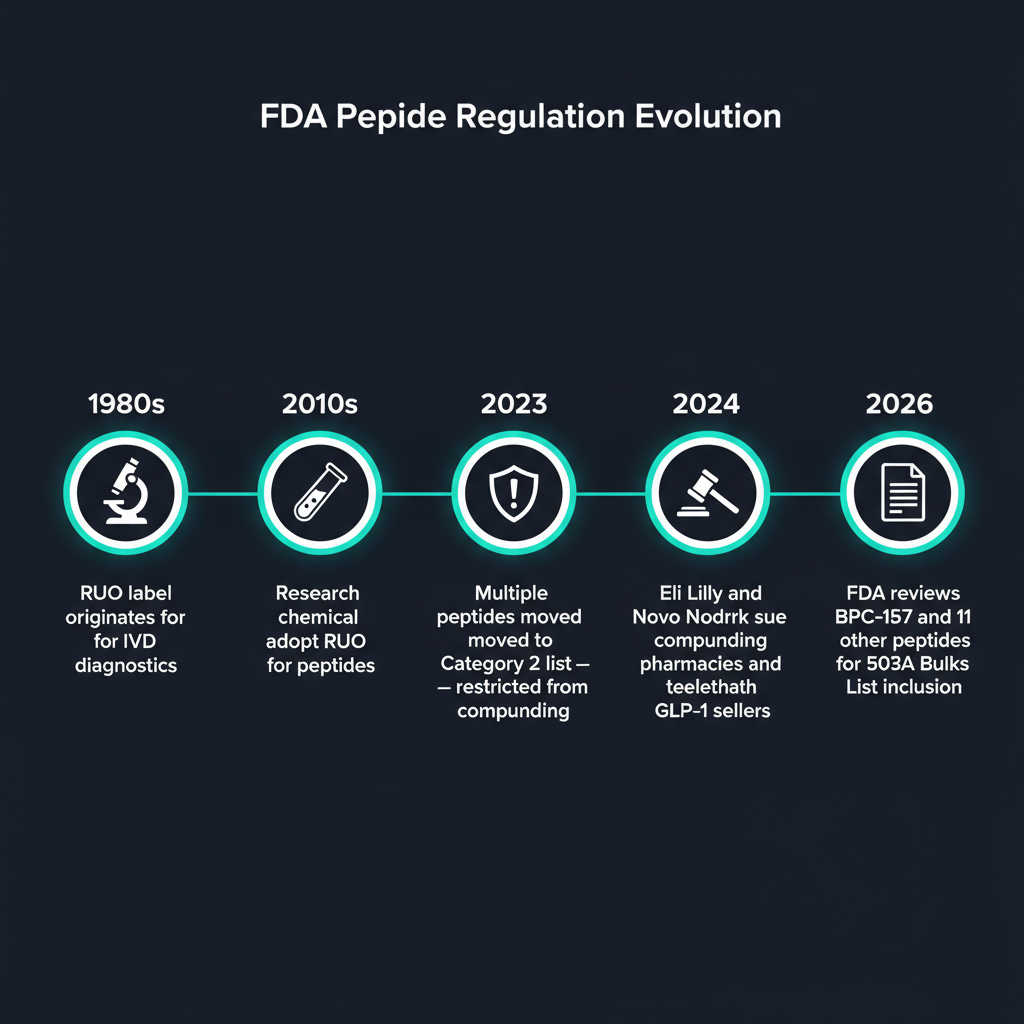
The migration of the RUO label from diagnostic reagents to injectable peptides happened gradually, mostly through the early 2010s, as "research chemical" vendors moved beyond classical research compounds (novel psychoactives, designer stimulants) into the peptide space. The vendors that already had RUO-branded inventory simply added peptides to their catalogs under the same labeling convention. The label sounded scientific. It used the right words. And for a long time, enforcement was sporadic enough that the convention held.
What changed in 2024–2026 was the volume. The GLP-1 weight-loss revolution moved peptides from a niche bodybuilding interest into mainstream consumer demand. Online vendors followed, marketing "research peptides" with consumer-grade websites, telehealth-adjacent branding, and pricing optimized for individual buyers rather than institutional labs. At that scale, the legal mismatch stopped being theoretical. The FDA, FTC, and state attorneys general all took notice.
Where real RUO use exists
RUO peptides do have legitimate scientific applications. They support a meaningful share of basic research that would not be possible at pharmaceutical-grade cost or timeline. The legitimate uses share a structural feature: they happen inside an institutional framework with documented oversight, not inside an individual's medicine cabinet.
- Pre-clinical animal studies. Investigating mechanism of action in rodent and other animal models before any human trial is contemplated.
- Cell culture and in-vitro assays. Testing receptor binding, downstream signaling, and cellular toxicity in cultured cells — never administered to a living human.
- Assay development. Building and calibrating the analytical methods (HPLC, mass spec, ELISA) that will later be used to test pharmaceutical-grade material.
- Pharmaceutical R&D before IND. Drug companies use RUO-grade material in the earliest discovery phase, long before an Investigational New Drug application opens the path to human studies.
- Academic research. University laboratories investigating peptide biology under institutional IRB / IACUC oversight.
The common denominator is institutional purchasing, documented protocols, and ethics-board oversight. None of those exist when an individual buys a vial of "research peptide" with a credit card and a residential shipping address. The product is the same molecule. The framework around it is structurally different — and the framework is what RUO was designed to operate inside.
The FDA "totality of circumstances" test
When the FDA examines a peptide vendor, it does not stop at the label on the vial. It applies the "totality of circumstances" standard — the same standard used for RUO-labeled IVD products since the 2013 guidance — and asks a single question: what does the vendor's behavior, taken as a whole, indicate the product is actually intended for?
The following are the most common factors that reclassify an "RUO" product as an unapproved drug in the FDA's analysis. None of them are individually fatal. Several appearing together are.
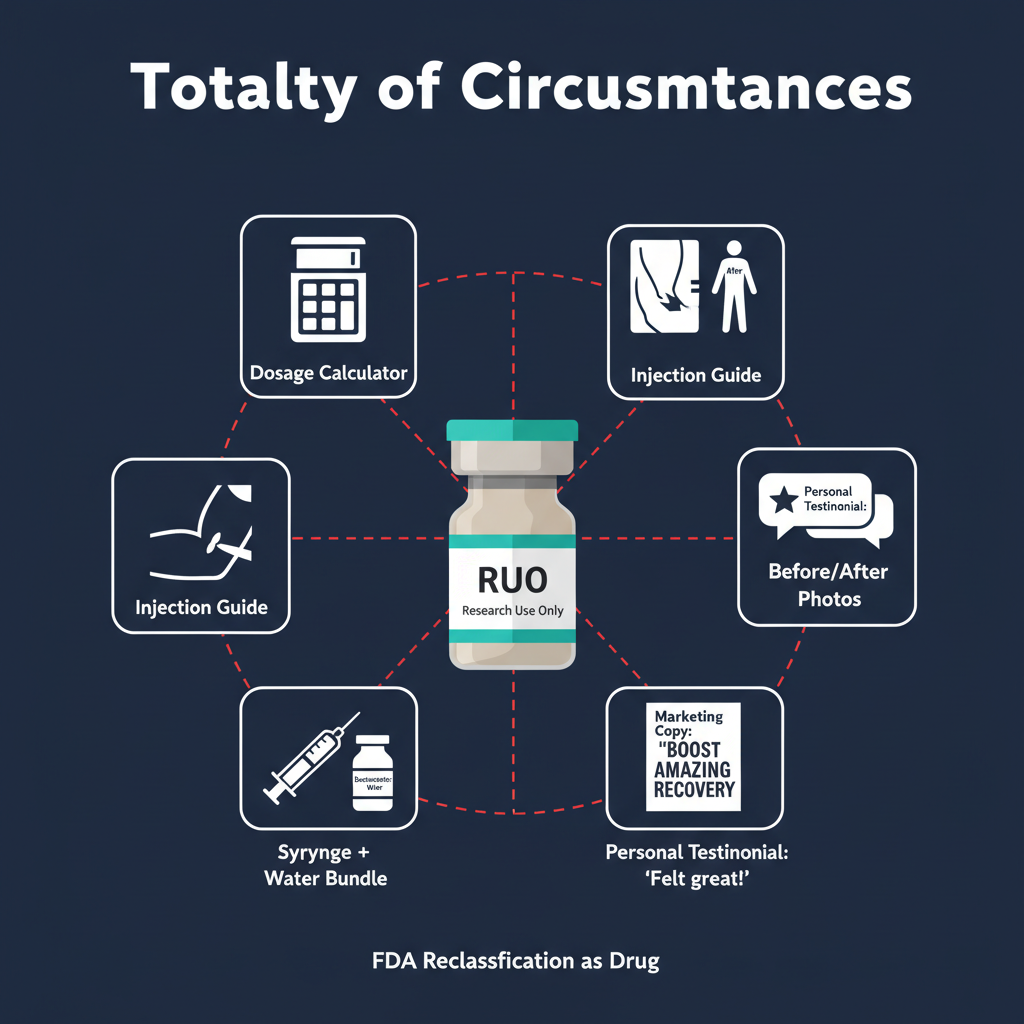
- Dosage calculators. A "BPC-157 dosage calculator" on a vendor's website is not a research tool. Researchers design protocols; they do not consume vendor calculators.
- Injection guides. "How to reconstitute and inject TB-500" with diagrams is administration instruction, not laboratory protocol. The audience is unmistakable.
- Before-and-after photos. User physique transformations are clinical-outcome claims. They have no role in any legitimate research context.
- Customer experience reviews. "I felt incredible recovery after week three" is a patient testimonial. Researchers do not testify about how molecules made them feel.
- Bundled injection equipment. Vendors who sell syringes, alcohol swabs, and bacteriostatic water alongside the peptide are selling an administration kit, not laboratory reagents.
- Therapeutic-claim language. "Anti-aging," "fat loss," "recovery boost," "feels amazing" — these are drug claims, regardless of the disclaimer beneath them.
- Pre-filled "research pens." Devices visually identical to prescription injection pens, pre-dosed, are administration devices in everything but the label. The visual mismatch alone is sufficient to invite enforcement.
Any one of these factors weakens the RUO defense. Three or more, in the FDA's typical analysis, collapse it entirely.
Research Grade vs. Pharmaceutical Grade — the actual gap
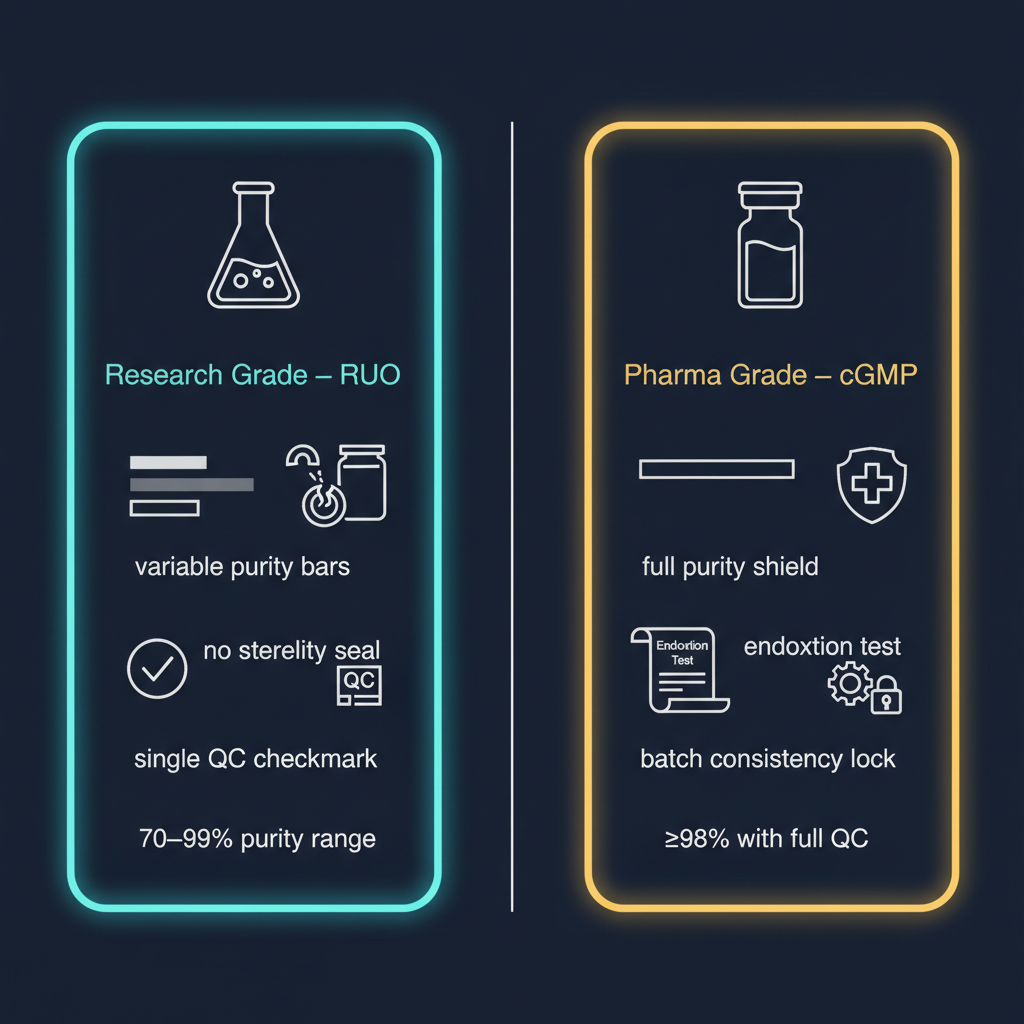
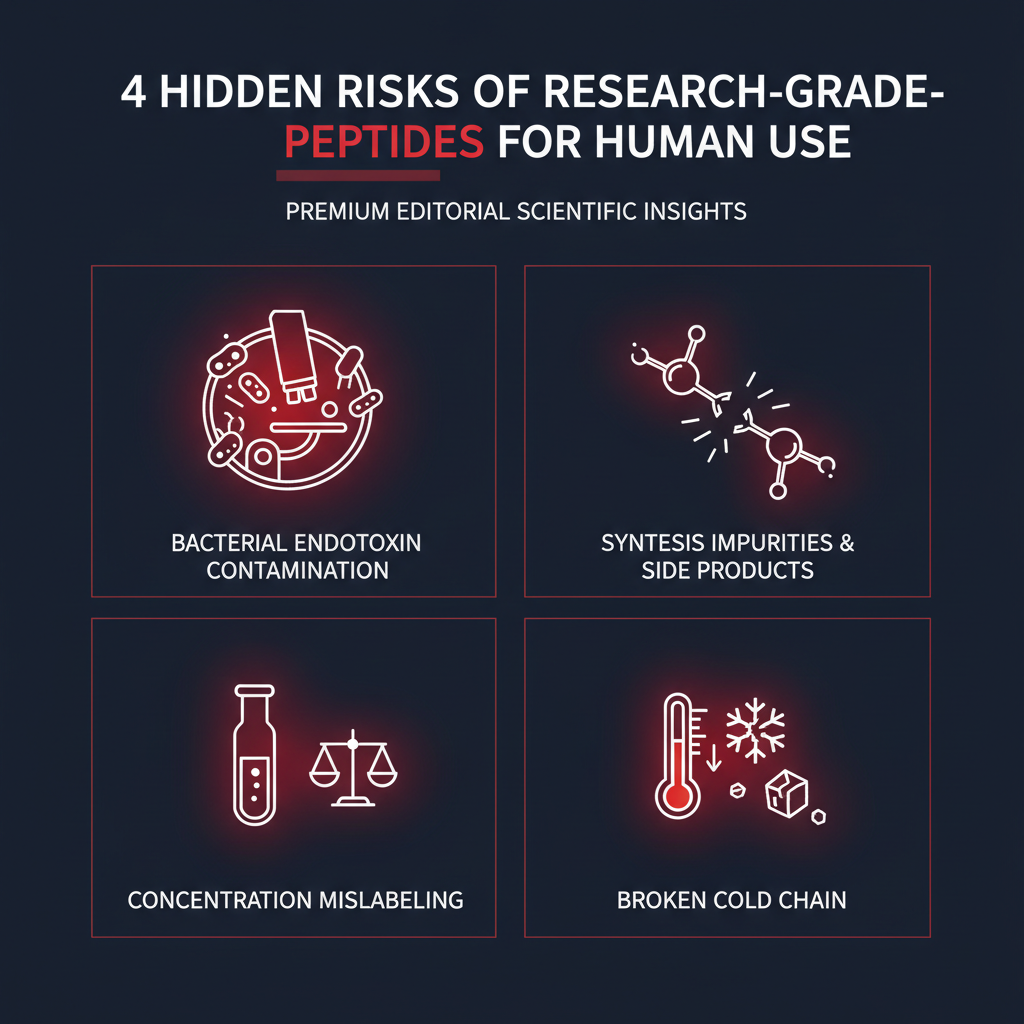
The most common misconception about research-grade peptides is that the only difference from pharmaceutical-grade is "they're not approved yet." The actual difference is structural and runs through every step of production, testing, and distribution. Purity is one variable among ten. The others matter just as much when the substance is going into a human body.
How the regulatory environment shifted
For roughly fifteen years, the online peptide market operated under benign neglect from U.S. regulators. The volumes were small, the audience was niche, and enforcement priorities lay elsewhere. That period ended in 2023.
In 2023, the FDA placed a group of peptides — including BPC-157, TB-500, Epitalon, Selank, Semax, MOTS-c, KPV, DSIP, injectable GHK-Cu, LL-37, DiHexa, PEG-MGF, and Melanotan II — onto its Category 2 list of bulk drug substances. Category 2 designation, in plain terms, means: this substance has raised significant safety concerns and may not be used in compounding under Section 503A pending further review. The legal pathway for U.S. compounding pharmacies to formulate these molecules for patient use was effectively closed.
In late 2024 and 2025, the GLP-1 storyline arrived. After the FDA declared the semaglutide and tirzepatide shortages resolved, 503A and 503B compounding of those molecules was no longer broadly permissible. Eli Lilly responded by suing telehealth companies and compounding pharmacies — most prominently Empower Pharmacy in Houston, and four telehealth defendants in cases filed in April 2025 — alleging continued manufacture and distribution of unapproved tirzepatide alternatives. Novo Nordisk pursued parallel actions targeting semaglutide compounds.
On July 23, 2026, the FDA's Pharmacy Compounding Advisory Committee (PCAC) is scheduled to revisit BPC-157 and related peptides, per Federal Register docket FDA-2025-N-6895. The committee will hear public input and may recommend reclassification, additional safety conditions, or continued Category 2 status. Whatever the outcome, it will reshape the legal landscape again — which is the only consistent fact about peptide regulation in this decade.
Peptides currently restricted from 503A compounding
The FDA placed the substances below in Category 2 in 2023, citing significant safety concerns. They cannot be used by 503A compounding pharmacies pending the Pharmacy Compounding Advisory Committee meeting on July 23, 2026 (Federal Register docket FDA-2025-N-6895).
- BPC-157Stomach-derived peptide; tendon / gut healing claims
- TB-500 (Thymosin Beta-4 fragment)Recovery and tissue repair claims
- Epitalon (Epithalon)Pineal peptide; longevity claims
- SelankRussian-developed anxiolytic peptide
- SemaxRussian-developed nootropic peptide
- MOTS-cMitochondrial-derived peptide; metabolic claims
- KPVAnti-inflammatory tripeptide
- DSIPDelta sleep-inducing peptide
- GHK-Cu (injectable)Copper peptide; topical is regulated separately
- LL-37Antimicrobial cathelicidin peptide
- DiHexaCognitive enhancement claims
- PEG-MGFPegylated mechano-growth factor
- Melanotan IITanning peptide; documented safety concerns
The GLP-1 litigation chapter
The semaglutide and tirzepatide compounding crisis is the most legally consequential development in the peptide market since the FDA's 2023 Category 2 designations. It is worth understanding in detail, because it sets the litigation pattern that will likely extend to other peptide classes.
The compressed timeline:
- 2022–2023. Soaring demand for semaglutide (Ozempic, Wegovy) and tirzepatide (Mounjaro, Zepbound) outstrips manufacturer supply. The FDA places both molecules on its Drug Shortage list.
- During shortage. 503A and 503B compounding pharmacies are legally permitted to formulate compounded versions of drugs on the Shortage list for patient use. Compounding GLP-1 production scales dramatically. Telehealth companies build entire businesses around delivering compounded GLP-1s by mail.
- Late 2024 / early 2025. The FDA declares the tirzepatide and semaglutide shortages resolved. Compounding of branded equivalents is no longer broadly permitted under standard 503A / 503B rules.
- April 2025. Eli Lilly files lawsuits against four telehealth companies — including those selling tirzepatide-based products — alleging unauthorized manufacture and sale of unapproved drugs. The Lilly v. Empower Pharmacy case in Houston becomes a focal point.
- Throughout 2025. Novo Nordisk files parallel actions on semaglutide. Most legitimate compounding pharmacies cease GLP-1 production. Demand migrates either to specialty exemptions (allergies to approved-product excipients), to the gray market, or to imported supply.
- Counter-suits. At least one compounder has filed counter-claims against Lilly and Novo, alleging that the manufacturers are using shortage-list timing to suppress legitimate compounded access. The litigation is active.
For the rest of the peptide market, the GLP-1 chapter is a preview. It demonstrates that pharmaceutical manufacturers will litigate aggressively when a compounding pathway intersects with a high-revenue branded product, and that the legal status of a peptide can change inside of a single quarter. Any clinician or buyer relying on "compounded BPC-157 was available last month" is reasoning from a static snapshot of a dynamic system.
EU, UK, Canada, Israel — same logic, different language
The FDA framework is the most-cited because the U.S. market is the largest and the enforcement record is the most detailed. The underlying logic, however, is global. There is no major Western jurisdiction where "Research Use Only" provides legal cover for personal human use of an injectable peptide.
- European Union — Directive 2001/83/EC. Any product with a therapeutic claim or intended for human medicinal use is a medicinal product requiring EMA or national authorization. There is no "RUO loophole." Customs authorities in multiple member states routinely intercept peptide shipments.
- United Kingdom — MHRA. The same logic applies post-Brexit under UK Human Medicines Regulations. The MHRA has issued warnings about online peptide sales targeting consumer audiences.
- Canada — Health Canada. Peptides for human use require either Drug Identification Number (DIN) approval or operate through Health Canada's Special Access Program. Personal importation rules are narrow and frequently misunderstood by buyers.
- Australia — TGA. Operates under the Therapeutic Goods Act with a Special Access Scheme for unapproved therapeutic goods. The personal importation scheme has limits and does not provide blanket cover.
- Israel — Ministry of Health. Operates under the Pharmacists Ordinance with prescription requirements and parallel-import rules. Several peptides have been classified as substances requiring prescription, and a smaller number have been classified under "novel psychoactive substance" frameworks.
For country-by-country regulatory status of individual peptides, PepVero maintains a structured regulatory database. The legal status of a peptide in your jurisdiction is the single most important question to answer before any other consideration.
Practical guidance by user type
This article is documentary, not advisory. But the regulatory framework above implies different practical considerations depending on who is reading it. The notes below are not legal or medical advice; they are the questions a careful reader in each category typically needs to answer.
If you are a researcher in an institutional setting
- Document the purchase as an institutional acquisition, not a personal one — proper invoicing, institutional shipping address, tax-exempt or equivalent treatment.
- Confirm IRB / IACUC / IBC approval for the specific protocol before any use beyond chemical characterization.
- Require a third-party Certificate of Analysis for every batch, with batch numbers cross-checked against the physical vial.
- Document cold-chain integrity from receipt through use; deviations are an experimental variable.
If you are a licensed clinician
- For any clinical use, source through a 503A or 503B compounding pharmacy under prescription — not through any RUO channel, regardless of the vendor's quality claims.
- Verify the specific peptide is not currently on the Category 2 list before prescribing. The list is updated periodically, and a peptide available last quarter may not be available this quarter.
- Document API source from the compounding pharmacy in the patient record.
- Consult a healthcare regulatory attorney before introducing any novel peptide into your practice, particularly for any molecule near or on Category 2.
If you are a buyer or patient
- "For Research Use Only" on a vial you can buy with a credit card and have shipped to your home is not a quality signal. It is a legal posture by the vendor.
- The most important question is not "is this peptide good?" but "is there a regulated supply chain available to me for this peptide in my jurisdiction?" If the answer is no, every alternative carries the structural risks documented above.
- If you are working with a prescribing clinician, ask explicitly which compounding pharmacy will fill the prescription, and verify that the pharmacy is properly registered and that the peptide is not currently restricted.
How PepVero uses this framework
PepVero does not sell peptides, recommend vendors, or endorse RUO products for human use. Our role is to document the regulatory and scientific record — the FDA categorizations, the Federal Register dockets, the USP standards, the active litigation, the country-by-country status — so that researchers, clinicians, and informed readers can apply the framework in their own jurisdiction.
What we publish for each peptide:
- Current FDA compounding category (Category 1 / Category 2 / unreviewed), with the Federal Register reference and the date of last review.
- Country-by-country legal status across the U.S., EU, UK, Canada, Australia, Israel, and additional jurisdictions where primary-source data is available.
- Evidence score for the underlying molecule, separable from any commercial claim.
- API manufacturer chain where the peptide is a component of an FDA-approved drug and the manufacturer is documented in public regulatory filings.
Everything in this article is verifiable against primary sources cited in the editorial note below. Nothing in it requires you to trust PepVero. That is the point.
Frequently Asked Questions
Verify the regulatory status of any peptide.
PepVero indexes the current Category 1 / Category 2 / unreviewed status of bulk drug substances under FDA Section 503A, plus the regulatory classification of each peptide in 7+ jurisdictions. Updated against primary sources after every FDA PCAC meeting.
Editorial standards & sourcing: All factual claims in this article are cross-checked against primary sources: FDA bulk drug substances guidance, Federal Register PCAC docket FDA-2025-N-6895 (BPC-157 and related peptides scheduled for review July 23, 2026), 21 CFR 809.10(c) for RUO labeling, the FDA guidance "Distribution of IVD Products Labeled Research Use Only or Investigational Use Only", and USP general chapters <71>, <85>, <795>, and <797>. Litigation context is drawn from court filings in Eli Lilly v. compounding and telehealth defendants (2024–2025). PepVero is not a law firm; this article is for educational use only and does not constitute legal or medical advice.
Last reviewed: May 13, 2026 · Next scheduled review: after FDA PCAC meeting July 23, 2026.