How to Choose a Peptide Provider: The 2026 Trust Framework
Most peptide-supplier guides are written by vendors. This one is not. Here's how to evaluate any peptide source against the same framework regulators, pharmacists, and CDMO procurement teams actually use — explained for researchers and clinicians, not for marketing.

The peptide market in 2026 looks nothing like the peptide market of five years ago. GLP-1 weight-loss drugs went mainstream, compounded peptides became a regulatory flashpoint, and the gap between regulated pharmaceutical-grade peptides and internet-sold "research chemicals" widened into a chasm. The result: choosing a supplier is now the single highest-risk decision in any peptide protocol — higher than the choice of peptide itself.
This guide explains the framework that pharmacists, CDMO procurement teams, and regulatory consultants actually use to evaluate peptide sources. It is supplier-agnostic by design. We do not recommend, link to, or rank vendors. We give you the same evaluation criteria a regulator would — and let you apply them.
Why supplier choice matters more than peptide choice
For an approved pharmaceutical peptide like semaglutide, the molecule itself is identical whether it comes out of a Novo Nordisk vial or a 503B compounding facility. What differs — and what determines safety — is everything around the molecule: identity, purity, sterility, endotoxin levels, formulation excipients, container integrity, and chain of custody.
A 2024 analysis of compounded GLP-1 products by the FDA found both sub-potent and super-potent samples in the same supply pool. A 2023 academic survey of online "research-grade" BPC-157 found mass-spec identity confirmation in fewer than 60% of products tested. Neither result is about the peptide; both are about the supplier.
This article focuses on the supplier evaluation framework. For the safety profile of a specific molecule, see the peptide's evidence-scored profile on PepVero.
The four supplier tiers (and who they're for)
There is no single "peptide market." There are four parallel markets with different regulators, different buyers, and very different trust profiles. Confusing them is the most common mistake new buyers make.
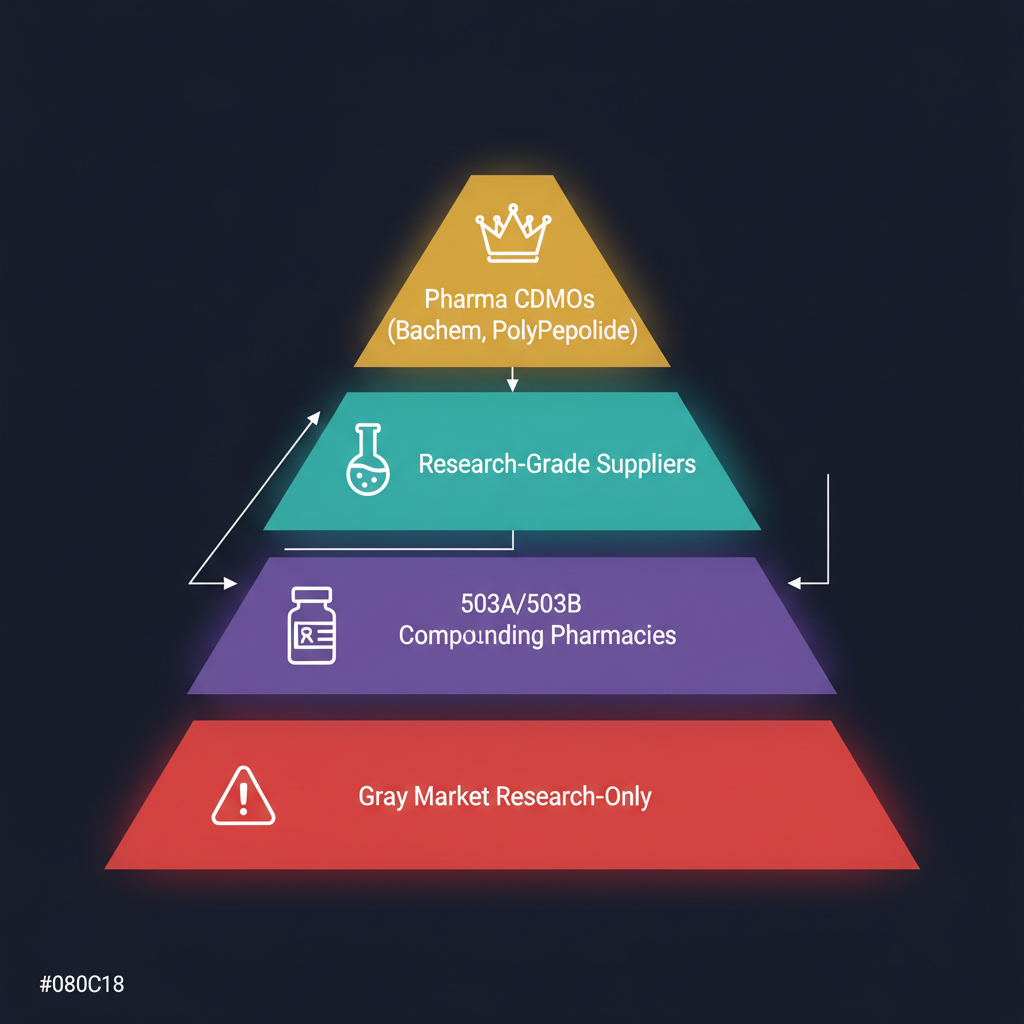
Tier 1 — Pharmaceutical CDMOs
A CDMO (Contract Development & Manufacturing Organization) is a contract manufacturer that produces the Active Pharmaceutical Ingredient (API) for drug companies. When you take a semaglutide injection, the peptide inside almost certainly came from one of a handful of large CDMOs — most famously Bachem (Switzerland, ~50 years of peptide synthesis experience), PolyPeptide Group (Sweden / U.S.), and AmbioPharm (South Carolina, U.S.).
These facilities operate under full cGMP (Current Good Manufacturing Practice), are routinely inspected by the FDA, EMA, and PMDA, and supply the API for FDA-approved drugs. They do not sell to individuals. They do not sell to research-grade resellers in the consumer market. Their entire customer base is regulated pharmaceutical companies under multi-year supply agreements.
Why does this tier matter to a researcher who can't buy from it? Because "manufactured by Bachem for [approved drug]" is a verifiable, public-record fact — and a powerful trust signal in the regulatory documentation of any approved peptide. PepVero documents these API supplier links when they appear in public filings, so you can trace a peptide's pharmaceutical lineage independently.
Tier 2 — Research-grade suppliers
These suppliers serve academic and biotech laboratories. Names you'll see in published Methods sections include Biosynth (which consolidated Vivitide, Pepscan, and Cambridge Research Biochemicals), MilliporeSigma (Sigma-Aldrich), and Phoenix Pharmaceuticals. They synthesize custom peptide sequences, ship internationally to institutional buyers, and provide a third-party Certificate of Analysis with each batch.
What makes a legitimate research-grade supplier:
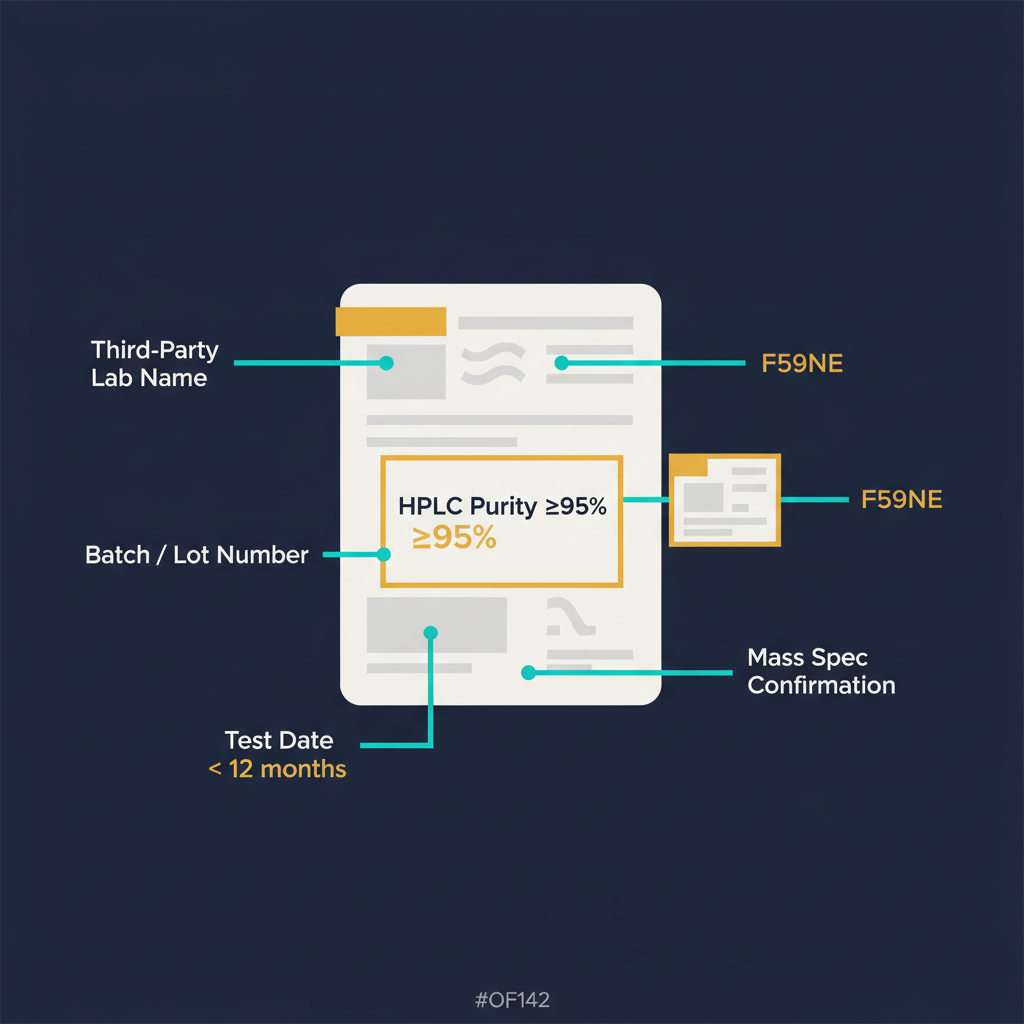
- Per-batch COA from an independent analytical lab — not a generic certificate copied across products.
- HPLC purity ≥95% as a published spec, with the chromatogram visible in the COA.
- Mass Spectrometry identity confirmation on every batch.
- Institutional invoicing — proper VAT, EIN/EORI numbers, real shipping addresses.
- "For research use only" labeling on the product and consistent absence of human-use marketing or dosing protocols.
The reputable tier-2 suppliers will not publish "how to inject" guides. They sell to scientists who design their own protocols within an institutional framework. The moment a "research grade" vendor starts publishing weight-loss or muscle-building guides, they have crossed into tier 4.
Tier 3 — 503A / 503B compounding pharmacies
In the United States, the legal pathway for a peptide that is not commercially available as an FDA-approved drug goes through compounding pharmacies, which operate under Section 503 of the Federal Food, Drug, and Cosmetic Act. There are two sub-categories with sharply different rules.
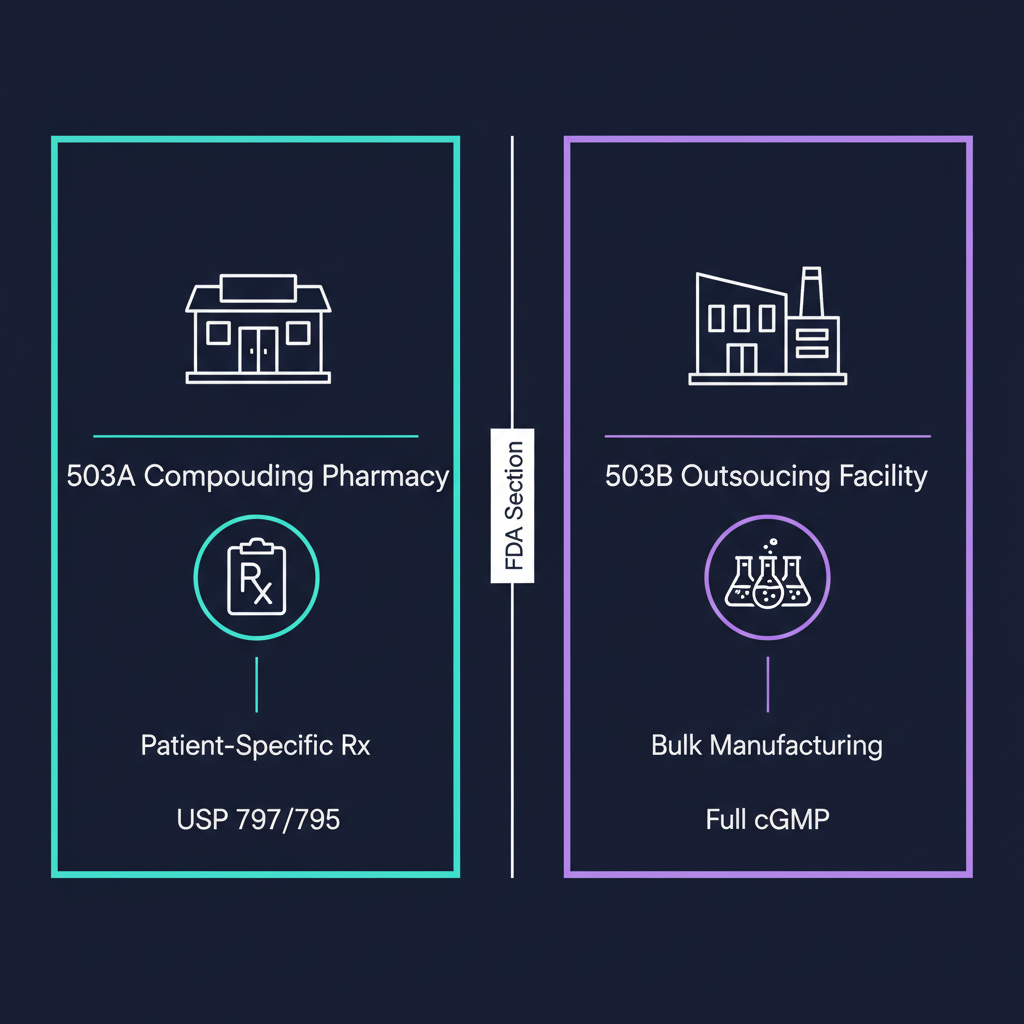
503A — patient-specific compounding
A 503A pharmacy compounds drugs for individual patients on receipt of a valid prescription from a licensed prescriber. It follows USP <795> (non-sterile compounding) and USP <797> (sterile compounding) standards, and is licensed by the state board of pharmacy. It is not required to follow full cGMP, and it is not registered as a drug manufacturer with the FDA.
503B — outsourcing facility
A 503B outsourcing facility can manufacture compounded drugs in larger quantities — including without a patient-specific prescription — and ship them to clinics, hospitals, and physician offices. To do so it must register with the FDA, follow full cGMP, and undergo periodic FDA inspections. The bar is closer to a small pharmaceutical manufacturer than to a traditional pharmacy.
The Category 2 list
The FDA maintains a Category 2 list of bulk drug substances that have raised significant safety concerns and may not be used in compounding under 503A. The list is updated periodically. Several peptides commonly discussed in fitness and longevity contexts have appeared on or near Category 2 — which is why a compounded peptide that was available last year may become unavailable from licensed sources this year. The list is the single most important regulatory document to check before assuming a peptide can be legally compounded for human use.
Tier 4 — The gray market (and why it's risky)
The fourth tier is not a tier the industry recognizes. It exists in the space between tier 2 and tier 3: websites that sell peptides labeled "research use only" while marketing them, in everything but the fine print, for human use. They publish reconstitution guides. They publish weight-loss protocols. They sell pre-filled "research pens" that happen to look exactly like prescription injection devices.
The fundamental problem is not always quality — some of these vendors do publish real third-party COAs. The problem is structural:
- The "research only" label provides legal cover for the vendor while shifting all risk to the buyer.
- There is no clinical chain of custody — no prescriber, no pharmacist, no formulary review.
- If something goes wrong (contamination, sub-potency, allergic reaction), there is no regulator who will investigate.
- Cross-border shipments may be intercepted at customs, and possession of an unapproved injectable carries its own regulatory exposure.
This is the tier most online "how to choose a peptide vendor" guides are actually about. We treat it as a category to identify and avoid, not a category to optimize within.
Anatomy of a real Certificate of Analysis
The Certificate of Analysis (COA) is the closest thing the peptide world has to a passport. A real COA is a short, dense, technical document — not a marketing flyer. It answers two questions: what is in this vial and how pure is it. If you cannot answer both questions from the document, the document is not a COA.
How to verify a COA in 60 seconds
A PDF on a vendor's website is not verification. Verification means going to the testing laboratory directly and confirming that the report exists, that it matches the vendor's claim, and that it has not been altered. Most reputable analytical labs that serve the peptide industry now provide a public verification page for exactly this purpose.
- Find the report ID. A real COA has a unique identifier near the top — typically alphanumeric, often beginning with the lab's initials.
- Go to the lab's verification page directly. Do not click a link on the vendor's site — type the lab's domain manually. Janoshik Analytical, one of the most cited labs in the peptide space, publishes a verification lookup at
janoshik.com/verify. - Enter the report ID. A valid report returns the original document (or a hash of it) showing the same peptide, the same batch, and the same purity result.
- 404 or "not found" means the COA is fabricated, altered, or was issued to a different vendor. Either way, the document is not validly assignable to this product.
- Cross-check the batch number on the physical vial. If the vial says batch
240514-Abut the verified COA is for batch240301-B, the COA does not describe what you received.
Sixty seconds of verification removes more than 90% of the supplier risk in the gray market. It is the single highest-value habit in this entire framework.
9 red flags of a scam vendor
Most peptide scams do not look like scams. They look like normal e-commerce, sometimes with surprisingly polished branding. The signals are in the structure of the business — payment methods, contact options, claimed history, the consistency between what they label and what they market.
Any one of the flags below is concerning. Any two together is disqualifying. Three or more is unambiguous.
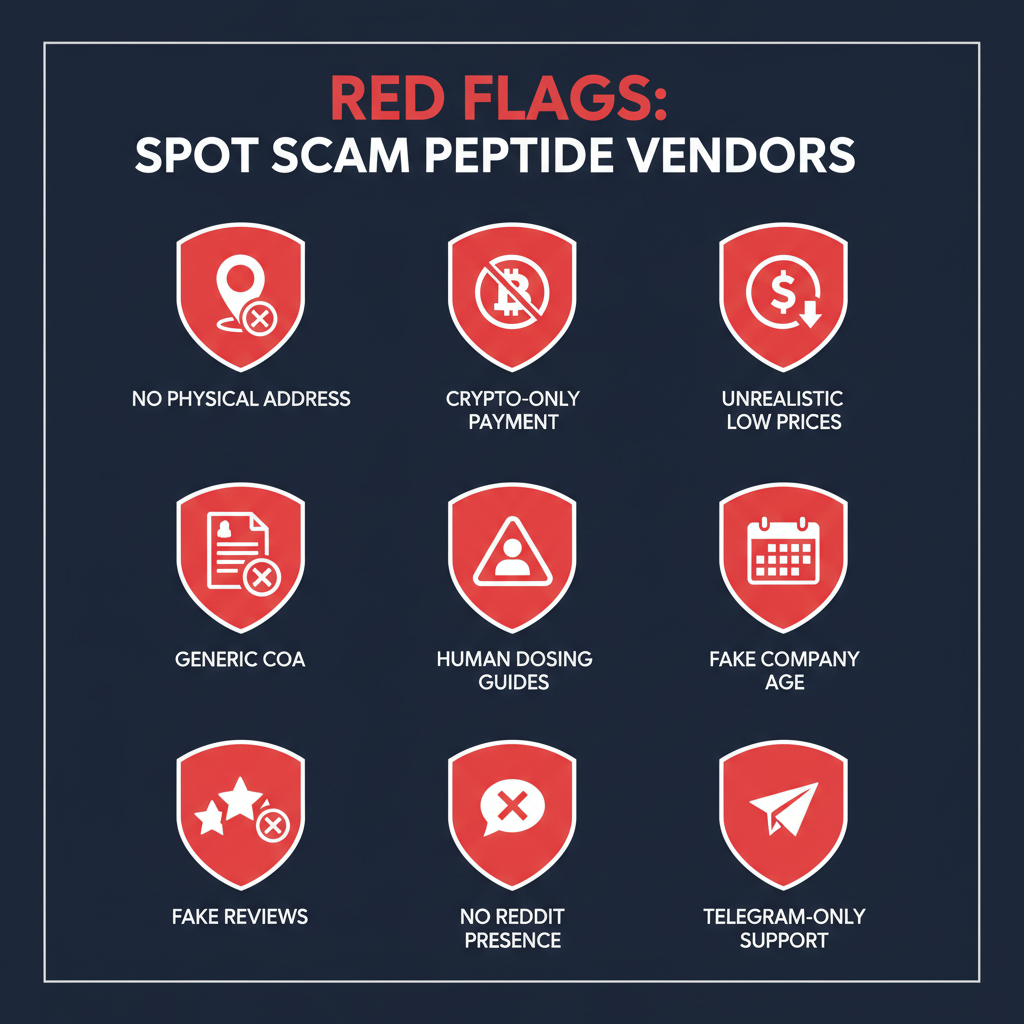
Only a contact form, PO box, or vague "USA-based" claim with no verifiable location.
No credit card processor will underwrite the merchant — usually because the chargeback risk is too high.
Real research-grade peptide synthesis has a real floor cost. Deep discounting almost always means substitution or contamination.
Each peptide and each batch needs its own COA. A single PDF reused site-wide is fabricated.
A direct regulatory contradiction. The label says one thing; the marketing says another.
"Serving researchers since 2009" on a domain registered in 2024. Check WHOIS or web.archive.org.
50 five-star reviews posted in a single week, all from accounts with zero other activity.
Legitimate suppliers are discussed organically over months and years — not just on the vendor's own page.
No accountability, no ticketing, no recourse if something goes wrong with a shipment.
FDA 503A vs 503B: the legal compounding framework
For U.S. clinicians considering a compounded peptide, the relevant question is not "is this peptide good?" but "can it legally be compounded under 503A or 503B for this patient?" The answer depends on three layers of regulation:
- Is the peptide on the FDA's bulk drug substances list? A 503A pharmacy may compound from a bulk substance only if it is on the relevant approved list, is a component of an FDA-approved drug, or has a USP monograph. 503B has parallel rules under Section 503B(a)(2).
- Is it on the Category 2 list? Category 2 substances are excluded due to documented safety concerns. The list is the FDA's regulatory mechanism for restricting compounded substances without going through a full drug approval process.
- Is there a commercially available, FDA-approved equivalent? Compounding generally cannot be used to recreate a drug that is already available — except in cases of shortage or specific patient need (e.g. an allergy to an excipient in the approved version).
This framework is opaque from the outside, which is precisely why some clinicians end up sourcing from the gray market: the legal path is narrow and changes frequently. The opacity is not a reason to bypass the framework. It is a reason to confirm current status, in writing, before any clinical use.
The 16-point pre-purchase checklist
This is the single artifact most worth saving from this article. It collapses the entire framework above into 16 yes/no questions across two phases: before you source, and after the package arrives. If you cannot answer "yes" to every item in the relevant phase, do not proceed.

Before sourcing
- The vendor has a verifiable physical address (not a PO box or contact form).
- The Certificate of Analysis is issued by an independent third-party laboratory.
- You can externally verify the COA (report ID lookup, public verification page).
- HPLC purity result is shown and is ≥95% (≥98% preferred for research use).
- A Mass Spectrometry result confirms the molecular identity.
- The COA test date is within the past 12 months.
- The lab name on the COA is named, real, and reachable.
- The product is discussed on independent forums (Reddit, peptide research communities) — not only on the vendor's own site.
After delivery
- The batch / lot number on the physical vial matches the COA exactly.
- The packaging seal arrived intact and not tampered with.
- You re-verified the COA on the lab's public verification page after delivery.
- Storage on arrival followed manufacturer guidance (typically −20 °C, protected from light).
- Reconstitution and handling follow the peptide's published stability profile.
- Any clinical use is on a valid prescription, from a 503A or 503B pharmacy where applicable.
- Adverse events or off-target effects are documented and reported.
- The vendor is re-evaluated against the same framework before any future order.
How PepVero stays neutral — and why that's the value
Every peptide content site eventually faces the same fork: recommend specific suppliers and monetize the affiliate link, or stay neutral and monetize trust. We have chosen the second path, and we want to be explicit about why.
Supplier landscapes are not static. Pharmacies lose accreditation. CDMOs change ownership and quality control. Websites rebrand overnight. A "trusted vendor" list published today is misleading in eighteen months and dangerous in three years. Affiliate-driven supplier recommendations are also a fundamental conflict of interest with the publication's regulatory and scientific neutrality.
What PepVero does provide:
- Verifiable, public-record API manufacturers for peptides that are components of approved drugs (e.g. "the API for [approved drug] is manufactured by [public-record CDMO]"). This is documented science, not an endorsement.
- Regulatory status by country — drawn from FDA, EMA, MHRA, TGA, PMDA, Health Canada, AEMPS, Israeli Ministry of Health, and equivalent national authorities.
- Evidence scores and peer-reviewed studies for the molecules themselves, so the underlying science is separable from any commercial claim.
Everything in this guide is information you can verify against primary sources. Nothing in it requires you to trust PepVero. That is the design.
Frequently Asked Questions
Verify any peptide claim with primary sources.
PepVero indexes 260+ peptides with evidence scores, peer-reviewed studies, regulatory status by country, and known commercial-grade API manufacturers (when public record). Built for researchers and clinicians — not for shopping.
Editorial standards: This article was written by the PepVero Research Team and cross-checked against primary sources: FDA 503A/503B documentation, USP 795 / USP 797 chapters, EMA peptide GMP guidance, and publicly listed CDMO regulatory filings. PepVero does not sell, endorse, or receive compensation from any peptide supplier mentioned. This guide is provided for educational purposes only and is not medical, legal, or purchasing advice.
Last reviewed: May 13, 2026 · Next scheduled review: November 2026.